Showing posts with label Township. Show all posts

Thursday, March 1, 2012

Cape Town (Day 6) Operation Hunger

   Volunteering with Operation Hunger was an amazing experience!  It was a long, difficult day and worth every extra heartbeat.  For a little background about Operation Hunger, it was started in 1980 a an organization that gave out food to populations at risk for malnutrition.  Through their work, they realized that additional programs such as health education and sustainable agricultural projects were needed.  Now the organization battles hunger in South Africa on many fronts.  In 1992, Clement, the regional coordinator for the Western Cape started working with Semester at Sea and we have had a wonderful relationship ever since.  I was especially excited when I learned this because the previous service projects I have participated in seem so fleeting and only addressed the surface of larger problems.  SAS's long term relationship with Operation Hunger meant that the two programs had grown together and were better able to fulfill each other's needs. 


  On the service visit, we were able to help in several different ways.  The first half of the day (after a tour and introduction) was spent doing one of three things; cooking in the soup kitchen, breaking ground for a new garden, and assisting the videographer and photographer film and photograph the community.  I was really excited to be asked to assist the photographer (he has been helping me with my photo skills while at sea) but had forgotten that I used a wheelchair sometimes so I actually couldn't go.  It was REALLY disappointing for me because it was kind of an honor to be hand-picked by him and then I couldn't do it.  I pouted a little and then decided to give myself over to my new task which would be gardening.  One may think that photography is a better suited activity for someone using a wheelchair than farming, but I am actually quite handy with a hoe and rake in my chair, and quite unable to take photos while wheeling myself.  


   I knew that it may be a challenge to convince people that I could help just as well as anyone else, so I made sure to present myself in a non-helpless manner.  I wheeled right up to the back of the truck we were unloading and picked out a hoe before anyone could tell me I could just sit and watch.  The ground that was going to become a large garden looked nothing of the sort when we began.  It was a sandy and rocky plot with lots of weeds and litter.  That quickly changed though.  Those of us who had gardened before (or pretended to know what we were doing in my case) got to work turning up the soil and hacking out the weeds.  I worked out a pretty good system where I would sit and use my knee as a lever for the hoe.  I was having another pretty bad weakness spell, so I needed all the help from physics I could get.  I would make sure the area right around me was perfect and then wheel the chair back a few feet and work on the new area.  Once the hoeing was done, I went back through with a big rake to get the large weeds and rocks out and then back again on my hands and knees to get the more stubborn weeds out.  I stood up for some raking with the smaller toothed rake to make sure everything was level and looking pretty.  Other people went around and poured water over the newly turned dirt and planted seeds in the wet soil.  I took a rest, talked with Clement about the History of Operation Hunger, and then got back to work with the hoe to better define the bed I was working on.  I was slower than most people, but I had fun and felt good about it still.  I had been really missing gardening while on the boat so it was nice to much about in the soil for a few hours.  I was really happy that no one tried to coddle me or prevent me from doing work.  Everyone just accepted that I would be working right a long with them.  The garden will eventually be taken over by the community as a sustainable way to produce food.  

  We drove to a large gas station for lunch where I had fun talking with people and having another delicious peanut butter milkshake from Whimpy's (a fast food chain).  I didn't really understand why so many of the other customers were staring at me in the gas station/fast food restaurant until I saw myself walking in the reflection of a window.  I look pretty darn awkward during a weakness spell!  I may need to rename the "zombie walk" to be my "spaz walk."  haha  


   After lunch we headed to the soup kitchen to help out with Operation Hunger's bi-annual data collection.  (It is bi-annual because SAS students are needed to help staff them and we come to Cape Town twice a year.)  My friend Josh and I secured a spot at the weighing station.  We weighted the kids and wrote their weight on their lower arm which would be recorded with their arm circumference and height by one of the Operation Hunger workers.  IT was extremely fun and chaotic.  I absolutely loved working with the kids in this setting.  I got to squeeze in some high fives and tickles even in the hectic process.  Some of the younger kids were a little scared and unsure, but Josh an did a good job of turning their whimpers into giggles, I think.  The data we collected would show which kids were at-risk for malnutrition.  Those kids would have follow up visits to their houses where nutritional education, medical care, and food donations would be provided if necessary.  

  After all the data was collected, the kids got to fill their bowls they brought from home with some vegetable stew the soup kitchen had prepared.  For some of the kids, it would be the only meal they had that day.  This showed in some of the kids who barely had any arm for me to write their weight on and had swollen bellies from lack of protein.  Most of the kids were of a healthy weight, but those who were not broke my heart.  I was hungry by the time we had lunch that day.  I can't imagine being a little kid and having hunger be a constant part of life.  Clement said that more than anything, he hopes that we will remember the community when we get back home and have the ability to send funds and supplies.  I know there is no way I can forget the organization or the community.


  I handed out some stickers and saucer poppers to the kids who hung around to eat which was really fun.  I had dozens of little hands all around me waiting to be decorated by the neon smiley face stickers I brought.  I was so busy with that, that I was almost late to the bus...again.  One of the Operation Hunger workers had to come fetch me and show me that everyone else was already on the bus.  Oops.  I gave some last high fives and showed some of the older ones my wheelchair and then got on the bus to go back to the ship.  I think it goes without saying that I didn't want to leave.

Bye Bye South Africa!  I will definitely miss you and be back soon!


Friday, February 24, 2012

South Africa! (Day 1)

    Previously, the only reasons I thought were valid to wake up before the sun rises were for a soccer tournament or to catch a plane.  Now I will add being rudely awakened by a giant swell and then getting to see the sun rise over Cape Town as we arrived to port.  :0)


(That glazed over look is 100% authentic.)  

   The morning was a bit of a disappointment.  I was supposed to go see the penguins on the coast with my friends but some questionable "planning" and my time constraints resulted in about an hour of walking and me abandoning the effort and heading back to the ship.  We tried to find a train with no luck, then a taxi, then a train again and couldn't find any of the above.  Still, it was nice to get off the ship and walk around a bit.  I stopped by an ATM to get that out of the way too.  I hadn't intended on walking that long or that far (I don't think some of the people I was with understood that I can't walk like they can.  One of the drawbacks of "looking fine") so I was very glad to give the whole thing up and spend a few hours resting.  (And finding creative ways to store my money apparently.)

  (Just try to find my equivalent of $3 now thief!  Muhahaha!  I win this round!)

   By the time I was supposed to meet for my field program, I was all ready and recharged.  The field program was to a township (where black or colored people were made to live during  Apartheid) to see what life was like and tour the medical clinic that worked with TB and HIV/AIDS patients.  As you can imagine, I was expecting some really sad experiences out of this.  I imagined the townships as places that people were forced to go and now can't get out of.  Nothing like actually going to a place to be proved completely wrong.  


  From the outside, the townships do look similar to what one may imagine; lots of hodgepodge shacks squeezed together with dodgy looking electrical wiring.  Those are just part of the townships though.  People actually don't want to leave the townships for the most part, but rather aspire to live a good live within the community.  There are people of all socioeconomic statuses living there, so the usual goal of someone of lower socioeconomic status would be to move into a house, and then into a bigger house on roughly the same land.  In other words, it's not the cess pool of poverty and people wanting to escape it is often portrayed as in western media.


Also a common sight in a township along with even larger houses.

    There is great pride in being a member of the community in a township.  The township we visited, Khayelitsha, has it's own elected police force along with a culture of moral vigilantes who look out for the community.  This neighborly feel was based on the philosophy that no person lives in an isolated world.  EVeryone can offer help and will need help form others.  What I saw today in the townships contrasted completely with anything I had seen or heard about them before.  Even in class or the pre-port meetings we were warned that the townships were ripe with crime and drugs and not safe for tourists.  We got the impression that people living there were miserable and various social and political problems kept them from being able to move out.  I really can't reconcile these two impressions of life in the townships.  The truth is that I will really never know.  It is just as likely that the negative portrayal of the townships is based on fear and lingering racism as that we got a polished show of the townships because we were tourists.  

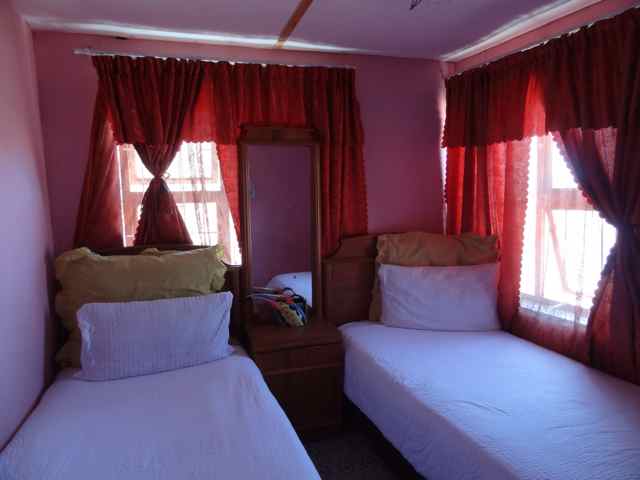
We visited three different organizations or businesses while we were at Khayelitsha.  Our first stop was at Vicky's Bed and Breakfast.  If you are still doubting that you would be comfortable while staying in a township, take a look at this!


Pretty nice eh?  The rates for the rooms and food were really good too.  I will definitely stay there when I come back someday.  Vicky, the women who started and runs the B&B had a really cool story about how it started.  She started out at the township in makeshift tents that were too small to fully stretch out in.  Over time, she acquired the means for a basic house that she shared with one other family.  She said that it was wonderful to have some privacy with the two room house, but it was still rather uncomfortable.  The two families had just one bathroom to share and there were only two bedrooms.  Her story skipped to when she decided to start offering tourists a place to stay in one of the bedrooms.  As money came in from that small business, she added on to the house to make it what it is today, a very comfortable and homey place with running water and electricity.  As her business was growing (as the many news articles on the wall will attest to) her neighbors started to wonder if she was in some kind of trouble.  All of these outsiders were coming and going from her house.  She started with word of mouth education about tourism and eventually would lead community meetings explaining tourism and the opportunities it presented.  Since then, the community has fully opened it's arms to the many tourists that stay in or visit Khayelitsha.  Vicky continues to help her community find new ways to integrate tourism opportunities as well as provide for the school aged children.  She organizes a big Christmas celebration every year where donated tooth brushes, socks, underwear, and school supplies are given to the kids.  (You can bet I will be bringing this up again to see if I can get a group together to send some donations.  Stay tuned or e-mail me if you are interested!)  She also helps organize trips for promising students to go to nearby museums and places of historical significance.  Vicky has done a lot of really awesome things for her community and demonstrated how one entrepreneur can do a whole lot of good.

Our next stop was to a program that provided for mothers who were having trouble providing for their kids.  Unlike in Ghana, teaching skills like weaving, sewing, and painting were an important addition to the community.  Women who were previously unemployed, can now go to this organization who will provide childcare during their handicraft training and work hours.  Their (beautifully made) products were sold in a small gift store and this provided them with income to help take care of their family.  The organization also educated the kids and moms about health and proper nutrition.  I had the opportunity to chat with some of the ladies working on purses and we traded stories on sewing projects that we were most proud of.  I was amazed that after a bit of practice they can make up to seven purses in an hour!  And these are really nice purses with lots of pockets and details!  I also had the opportunity to watch some other women as they worked on large weaving projects.  Everyone was really nice and graciously took time to explain what they were doing and answer questions.  


As I was waiting for the rest of the students to finish shopping, I spotted a group of kids who had gathered outside the compound.  They saw my camera and it was an instant sensation.  We passed my camera around taking pictures of each other and making silly faces.  I really just love how cameras provide such a fun way to meet new people!  I never had thought of cameras in that way before this trip.  


(Smiling is so boring so we chose goofy faces instead.)

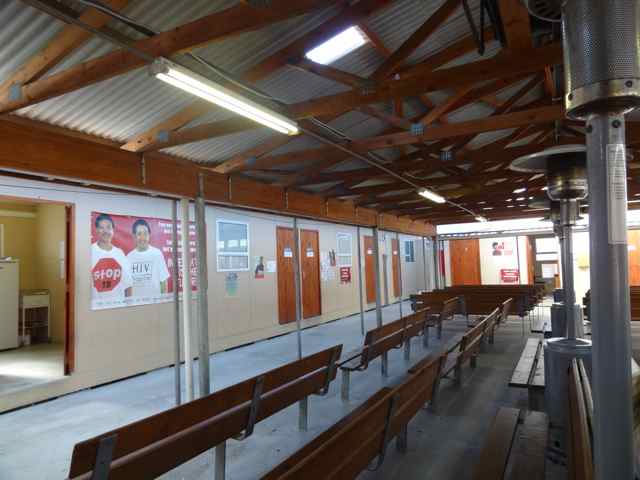
I expected our final stop to be very depressing as it was a health clinic that served primarily TB and HIV/AIDS patients.  If the years of media showing me really sad images of the AIDS epidemic in Africa, two articles I read before this field program gave more depressing news of how even when treatments are available, adherence is so minimal that there isn't much difference.  Once again, I found all of my previous notions proven wrong.  Rather than stories of disease and discouragement, the doctors and patients told ones of hope and achievement.  The clinic had a 85% adherence rate for the antivirals which is astounding!  I really hope that other clinics are figuring out what they do to be so successful and replicating  it.  The doctors and patients had to fight a tough battle to have HIV/AIDS even recognized by the government and now they are seeing patients be able to live almost normal  lives from this most feared disease.  The doctors were wonderful to take time at the end of a busy day to explain the science and sociology of what they deal with on a day to day basis.  We saw some cool x-rays and I basked in the microbiology jargon I hadn't even realized I had been missing.  

(Promising treatment aside, I hate to think how many of those test tubes will hold positive HIV tests tomorrow.  There are over 5 million people infected with HIV in South Africa.  Most of them don't even know it. )

The real stars of the show were the patients who spoke next.  I have spoken about some of my health problems for various groups before, but these ladies did so with such honesty and very eloquently and, most impressively, despite intense stigma about being HIV positive.  I can't imagine how brave they were to speak about their experiences to groups who may still not want to think about HIV/AIDS.  Still many times a month, them and a group of volunteer patients speak at schools, churches, and community meetings about the importance of prevention and testing as well as the options if infected with the virus.  I go back to the image of the meek and frail "patient" I had in mind before I got here and want to laugh at that old idea as it is replaced by these healthy, charismatic, and brave women.  I hate to use the "i" word, but they really were inspiring to any patients who don't want their illness to get the best of them. 


As is always the case, time moves on, and I had to get back on the bus.  (I was even a bit late.  oops!)  The drive back to the boat was pleasant as I was able to see beyond all the visions of an AIDS riddled Africa I was used to, and instead focus on all of the hope, success, and pride people were bringing to their communities.


And SOCCER!